(As an Amazon Associate I earn from qualifying purchases.)
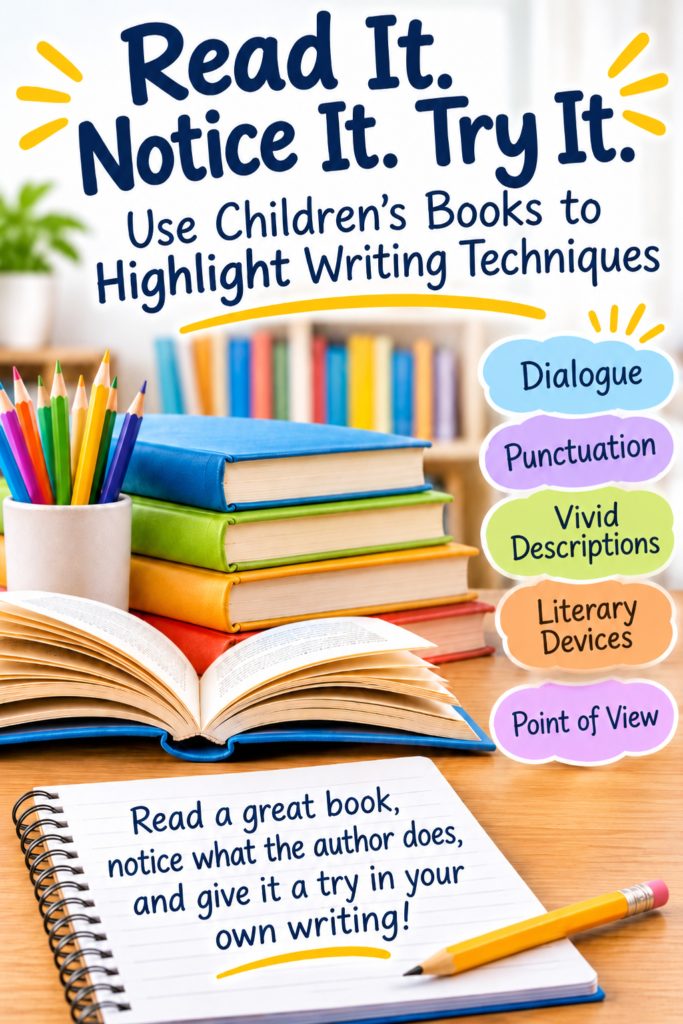
One of the best ways to learn to write well is to read good writing. We often learn something new by watching how someone else does it first. We imitate, experiment, and eventually develop our own way of doing things. Writing is no different.
Instead of relying solely on worksheets that teach writing skills in isolation, why not start with a good book? Read it aloud and enjoy the story. Then go back and highlight something interesting about the way the author uses words, sentences, or descriptions. Give your child a chance to experiment with that technique in their own writing.
It’s a simple, enjoyable way to connect reading and writing while helping kids find new ways to express their own ideas.
Book & Writing Activity Collection
Children’s books offer plenty of examples of writing techniques kids can explore and try for themselves. The activities below focus on five areas. For each one, you’ll find things to notice as you read, a simple writing activity, several book suggestions, and a link to a free related resource.
💬 Dialogue: How authors use conversations to bring characters to life
Dialogue is more than just characters talking. What they say, and how they say it, can reveal their personalities, show how they feel, and move the story forward.
What to notice:
- What do the characters say to each other?
- Can you tell how a character is feeling by what they say?
- Do the characters sound different from one another?
- Do they ask questions, argue, joke, or explain things?
- Does the conversation reveal something about a character or help move the story along?
Try it: Write a short conversation between two characters, animals, or even everyday objects. Give each one a distinct personality through what they say and how they say it.
Books Highlighting Dialogue:
| Last Stop on Market Street | CJ’s questions and Nana’s thoughtful answers show how conversations can reveal personality and relationships. | Discussion and Activity Guide |
| Clever Jack Takes the Cake | Jack’s exchanges with the people and creatures he encounters add humor and personality to his adventure. | Write your own fairy tale and more |
| My Rotten Redheaded Older Brother | Sibling rivalry comes through in the remarks and responses of the characters. | Activities Guide |
❗Interesting Punctuation: How punctuation changes the way writing sounds and feels
Punctuation can change how we read a passage, show emotion, create pauses, and help convey what a character is thinking or feeling.
What to notice:
- Does the punctuation make you pause, speed up, or change your voice when reading?
- How do quotation marks help you follow a conversation?
- What would happen if the author used a period instead of an exclamation point?
- How does punctuation help convey excitement, surprise, confusion, or other feelings?
Try it: Write a short conversation or mini-story using punctuation to show surprise, excitement, questions, and different ways of speaking. Read it aloud to hear how the punctuation changes the way it sounds.
Books Highlighting Punctuation
| Punctuation Takes a Vacation | A fun way to notice the different jobs punctuation marks perform and how they help make writing clear. | Activity Guide |
| Eats, Shoots & Leaves: Why, Commas Really Do Make a Difference! | Funny examples show how moving or leaving out a comma can completely change the meaning of a sentence. | Comma Posters & Activities |
| The Girl’s Like Spaghetti: Why, You Can’t Manage Without Apostrophes! | Humorous illustrations demonstrate how apostrophes distinguish possessives from plurals and help form contractions. | Apostrophe Worksheets |
👁️ Vivid Descriptions: How authors help readers picture a scene
Authors use descriptive words and sensory details to help readers imagine a place, person, or experience.
What to notice:
- What words or phrases help you picture what’s happening?
- Does the author describe what something looks, sounds, smells, tastes, or feels like?
- Which details help you imagine the setting?
- Which description stands out to you? Why?
Try it: Describe a familiar outdoor place using sensory details. Help someone imagine being there without showing them a picture. Include details about what they might see, hear, smell, or feel.
Books Highlighting Vivid Descriptions
| Fireflies! | Descriptions of the sights and sounds of the night and the use of imaginative comparisons. | Writing Activity |
| Saturdays and Teacakes | Rich sensory details bring to life visits to a grandmother’s home. | Descriptive Writing Exercises |
| The Raft | Descriptions of wildlife and the natural setting help readers experience summer adventures. | Sensory Details Worksheet |
✨ Literary Devices: How authors use language creatively
Authors sometimes use words and phrases in imaginative ways to make their writing more interesting, memorable, or fun to read. They might use words that imitate sounds (onomatopoeia), comparisons (similes), repeated beginning sounds (alliteration), or give human qualities to things that aren’t human (personification).
What to notice:
- Does the author use words that imitate sounds?
- Do any words or phrases repeat the same or similar beginning sounds?
- Does the author compare one thing to something else? What does the comparison help you imagine?
- Does something nonhuman act, think, or feel like a person?
Try it: Choose an everyday object, animal, or familiar place and describe it using one or more literary devices. Make up sound words, compare it to something unexpected, use alliteration, or give it human qualities. See how many different ways you can make an ordinary subject more interesting to read about.
Books Highlighting Literary Devices
| Owl Moon | Imaginative comparisons using similes, metaphors, and personification. | Activity Pack |
| Come On, Rain! | The author gives the weather and surroundings human qualities and uses unexpected comparisons. | Book study |
| Crazy Like a Fox | Figurative sayings matched with literal, humorous pictures. | Simile Slideshow Activity |
🎭 Point of View and Character Voice: How perspective shapes a story
Point of view is about who tells the story and what that storyteller knows or sees. Character voice is about how a narrator or character expresses themselves through their words, opinions, and personality. Both influence how readers experience a story.
What to notice:
- Who is telling the story? Is it a character or someone outside the story?
- Does the storyteller use words like I and we, or he, she, and they?
- Do we know what the storyteller thinks and feels? Are there things we don’t know because of whose perspective we’re following?
- Could another character tell the same events differently?
- Does the narrator have a particular attitude or opinion about what’s happening?
Try it: Retell a familiar event or a short scene from a different character’s point of view. What might that character notice, think, or feel? Use word choices and opinions that help readers recognize whose perspective they’re hearing.
Books Highlighting Point of View and Character Voice
| The True Story of the 3 Little Pigs! | The wolf presents his version of the familiar story in a conversational, self-defending voice. | Writing Activities |
| The Day the Crayons Quit | Each crayon writes a letter with its own concerns and personality. | Activity Pack |
Additional Writing Resources
While you don’t necessarily need a writing curriculum, sometimes you’re looking for a little more guidance or ready-to-use activities. These additional resources provide practice with punctuation, grammar, word choice, and creative writing.
Basher Basics: Punctuation: Gives punctuation marks their own personalities and lets them explain how they work.
Comic-Strip Grammer: Humorous cartoons introduce grammar concepts and give kids a chance to apply what they’ve learned.
Giggles in the Middle: Work through daily sentences that build skills in punctuation, usage, mechanics, and vocabulary, with additional writing assignments and mini-lessons.
DownWrite Funny: Silly illustrations and offbeat writing prompts to teach practical writing skills.
Related Articles: