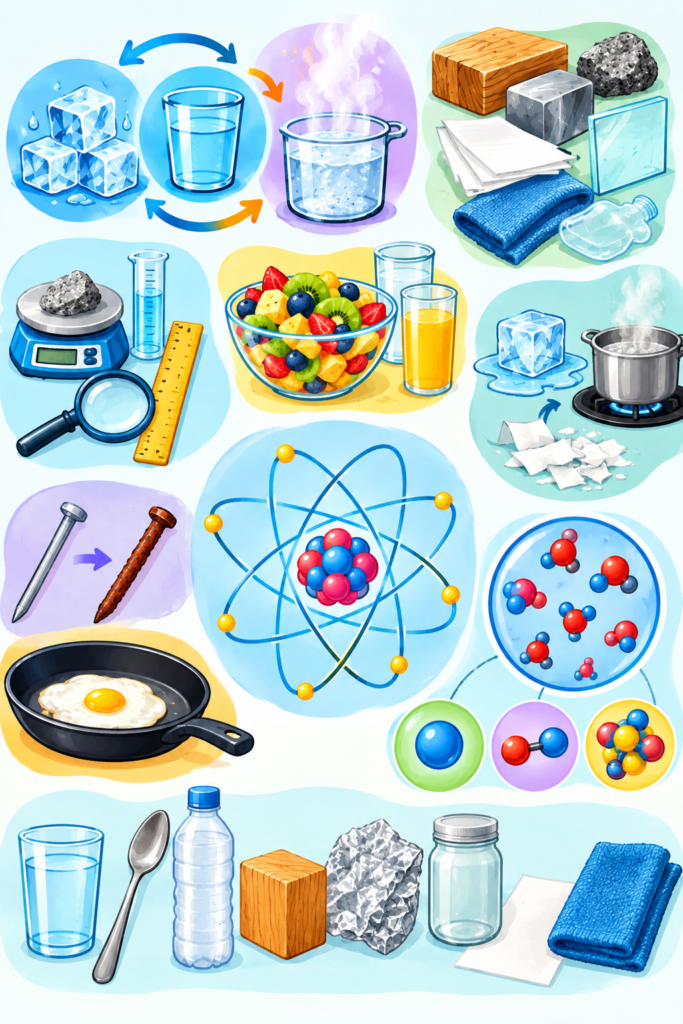
⚛️ Everyone makes oobleck with their kids at some point. It’s easy to mix up, kinda fun to play with, and strange enough to make you wonder what’s going on. Is it a solid or a liquid? Why does it flow through your fingers but become firm when you squeeze it? Questions like these give kids a chance to look closely at how materials behave. Making oobleck can be a fun way to start exploring matter and its properties. (Visit this Science Buddies oobleck page for a basic explanation of why it behaves the way it does).
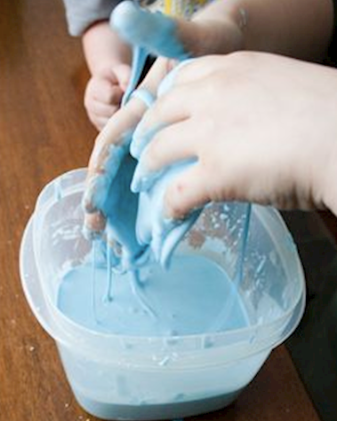
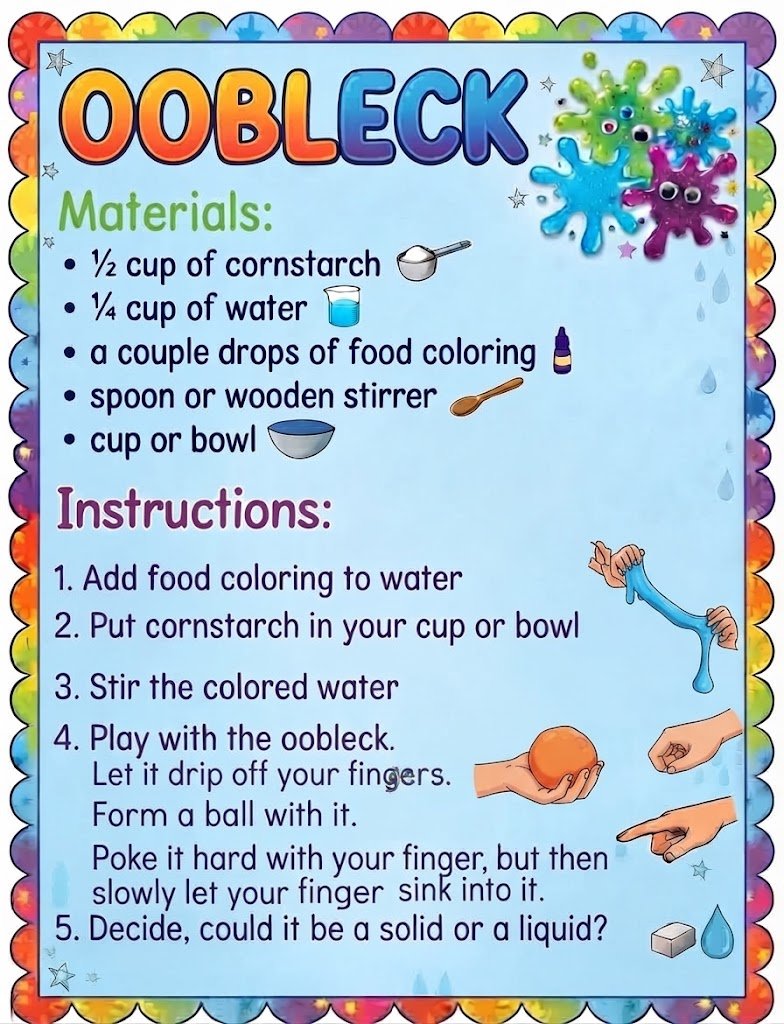
In this guide, you’ll find books and simple activities that help kids explore matter and materials, from solids, liquids, and gases to mixtures, physical and chemical changes, and the tiny particles that make up everything around us.
💡 What Kids Will Discover
As kids explore matter and materials, they’ll discover:
- what matter is and how it makes up the world around us
- how solids, liquids, and gases differ and how matter can change from one state to another
- how the properties of materials can be observed, measured, and compared
- how materials can be combined to make mixtures and solutions
- how physical changes can change the form or appearance of matter without creating a new substance
- how chemical changes create new substances with different properties
- how matter is made up of tiny particles, including atoms, elements, and compounds
- how the properties and changes of materials help explain the things we see and use every day
📚 Free Books
| Grades 3 – 5 | Grades 5 – 7 |
|---|---|
| Nonfiction | Nonfiction |
| What is Matter? Simple descriptions of solids, liquids, gases and changes | Matter Measuring matter, identifying substances, changes in matter |
| Mix it up: Solution or Mixture? Comparing and contrasting mixtures and solutions Understanding Chemical Reactions Bonds, physical changes, types of reactions, acids and bases, chemical equations and activities | Exploring Matter & Physical Changes Simple overview of matter examines properties, states, phases, and atomic theory Changes in Matter Physical and chemical changes, chemical reactions, real-life uses of chemistry |
| Breaking Down Chemistry Covers atoms, elements, compounds, reactions, beginnings of chemistry, and experiments | Properties of Matter Physical and chemical properties, changing states, elements and compounds, solutions and mixtures, plasma and superfluids |
| Investigating Atoms & Molecules Focuses on the basics of atoms and molecules, bonds, polymers | Atoms Structure of atoms, bonds |
| Thomas Edison Grade 4 biography Albert Einstein DK Life Stories | Women in Physical Science Notable discoveries and innovations in the field of physical science |
📚 Additional Books
(As an Amazon Associate I earn from qualifying purchases.)
| Grades 3 – 5 | Grades 5 – 7 |
|---|---|
| Nonfiction | Nonfiction |
| Physical Science Grade 5 Set focuses on chemical reactions, and states of matter | Exploring the Elements: A Complete Guide to the Periodic Table Explains each element’s properties, history, and real-world uses; younger kids can explore basics while older students dive into deeper chemical properties |
| Bounce: A Scientific History of Rubber Traces rubber’s journey from indigenous discoveries to modern inventions, weaving in the fascinating chemistry behind rubber’s stretchy, bouncy properties | Stuff Matters: Exploring the Marvelous Materials That Shape Our Man-Made World Explores the science of steel, glass, paper, concrete, foam, graphene, and more. |
| Who Was Marie Curie? Her life and discoveries of two elements | Isaac the Alchemist Young Isaac Newton’s early experiments with alchemy; includes illustrations from Newton’s own notebooks and period engravings Oppenheimer and the Atomic Bomb Bridges abstract physics concepts to real-world impact and historical significance |
| Explore Atoms & Molecules Projects Explore atoms, molecules, the periodic table, states of matter, and chemical compounds with 25 hands-on projects | The Kitchen Pantry Scientist Chemistry for Kids Pairs illustrated biographies of 25 chemists (from ancient history to today) with step-by-step hands-on experiments that kids can try using everyday kitchen materials |
| Fiction | |
| Kate the Chemist Series Kate solves real-world problems using hands-on STEM experiments and scientific thinking |
📚 Keep Browsing
Other places to find lists of fiction books by topic:
Reinforce what you’re studying while encouraging your kids to follow their interests. Check libraries for:
- books that explore everyday materials — metals, rocks, plastics, wood, glass, paper, fabrics, and other materials we use all around us
- books about changes in matter — melting, freezing, dissolving, mixing, cooking, rusting, and other changes kids can observe
- books that explore the tiny world of matter, from particles and atoms to elements and compounds
- books about scientists and inventors who have studied, discovered, or developed new materials
- hands-on science books with simple experiments for testing, comparing, mixing, separating, or changing materials
⚛️ Connect What You Read
Here are a few simple notebooking activities to help kids make connections between what they read and the materials around them.
🔎 Material Detective: Choose several everyday objects made from different materials—a spoon, piece of fabric, paper, plastic container, rock, wooden object, or metal tool. Examine and compare their properties. Which materials are hard or soft, flexible or rigid, smooth or rough, transparent or opaque, absorbent or waterproof? If you have a kitchen scale, ruler, or magnet handy, use them to do a few simple measurements or tests. Record your observations in a notebook, then choose two objects and explain why their materials are well suited to the jobs they do. You can also look for examples of the same material being used in different ways.
🧪 Mix & Observe: Choose two familiar materials and combine them in a clear glass or container. Try salt and water, sand and water, or oil and water. Observe what happens and record what you notice. Does one material dissolve? Do the materials remain separate? Does anything settle to the bottom? Then think about how you might separate the mixture again. For an extra challenge, compare your mixture with something from everyday life, such as lemonade, muddy water, trail mix, or salad dressing. Which are mixtures? Which contain a substance dissolved in another?
🧪 Elephant Toothpaste: Observe a chemical reaction. Activity instructions, explanations, and video.
🧪 All Mixed Up: Experimenting with mixing and separating.
🌎 Keep Exploring
Continue building physical science background knowledge with these free resources:
- PBS LearningMedia NOVA physical sciences
- Physical Science Virtual Activities
- Properties & Changes of Materials: Key vocabulary and facts
- Everyday Science: Matter in the Kitchen: Simple activities with free resources.
- Free Chemistry Resources
Khan Academy has a Middle School Chemistry unit that includes classifying matter, physical properties of matter, and chemical changes.
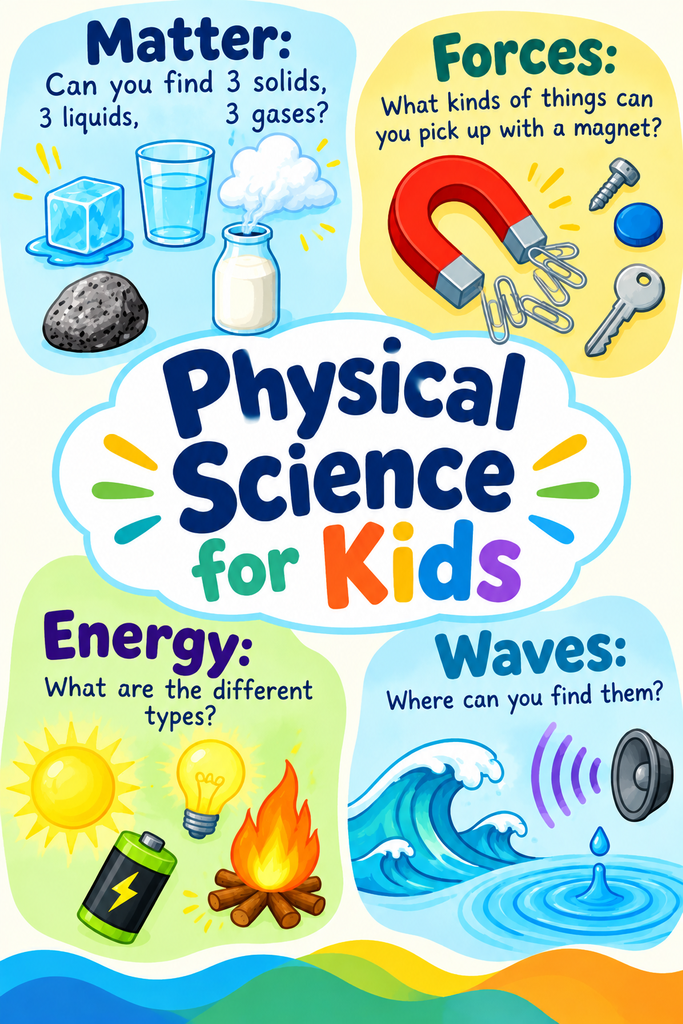
This 4-book set introduces younger kids to physical science topics covering: an explanation of matter and what makes up the physical world; different kinds of waves and how energy travels; gravity, magnetism and friction; heat, light and chemical energy.
(As an Amazon Associate I earn from qualifying purchases.)