
Geography was something I tried folding into whatever history we were studying – which worked to an extent. We’d read about the 13 colonies, label a map, answer some questions. Or we’d read about different ancient empires, label a map, answer some questions.
Not only was this kinda boring, but when we were studying a particular historical period, I didn’t always want to veer off into geography topics or jump to the modern map and cultures. I found it was more efficient and cohesive to cover those things on their own. I didn’t want to overcomplicate things with a bulky geography curriculum. Just something that provided repetition, variety, the ability to be used with multiple ages, and that didn’t necessarily depend on finishing a workbook.
That’s where, as a homeschooler, you don’t have to use a program, but create your own repeatable rhythm. One that mixes in map work with short readings, or online slideshows or videos you can put up on your TV screen, maybe some games, and quick reviews. It works with multiple ages at the same table or in your living room. And it can live wherever it fits in your day — morning basket, before lunch, after math, whenever.
You can follow a simple, flexible structure framed with: a lesson guide, map work, real-world cultural connection, and quick review.
Start with a Guide
You don’t need a full geography curriculum. You can work with a simple checklist like this one:
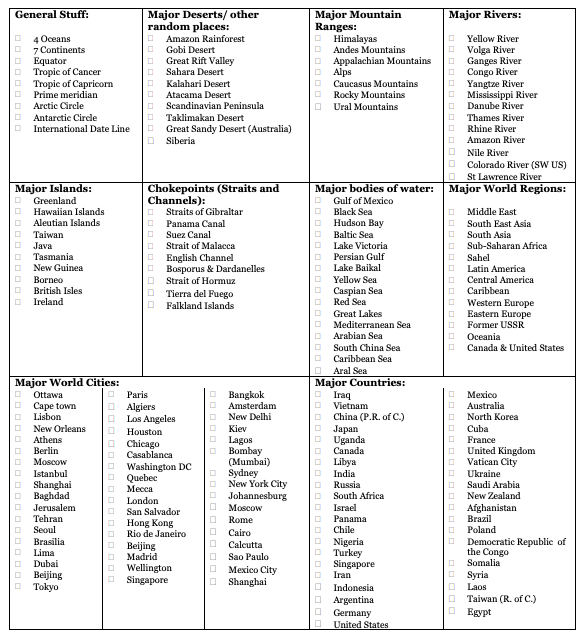
If you prefer, you can use one solid book or a well-organized online source that walks through the big pieces of geography in a logical order. Homeschoolers often call this type of resource a “spine.”
What A Geography Spine Covers
Things like map skills, the continents, oceans, landforms, regions, and countries. The spine simply gives you direction. It answers the question, “What are we covering next?” so you’re not guessing or constantly reinventing the wheel.
A spine can be something like the Usborne Geography Encyclopedia (#CommissionsEarned); or something that includes activities, like Complete Book of Maps and Geography (#CommissionsEarned). Or maybe it’s a book you find at your local library.
Here’s a well-organized free geography text online with clear sections you can move through at your own pace.
Online sources can work especially well for group reading. I liked pulling things up on my laptop and displaying it on the TV so we could all see the maps and images while reading and discussing together.
Read a few pages, skim the highlights, or pair the section with a short video. From there, you can add map work, notebooking, discussion, or simple reviews before moving on to the next section.
Do Something with a Map
Use the spine in conjunction with a big wall map or smaller maps, charts, or diagrams. Then do some activities like:
- pulling up a map and doing a labeling exercise using printable blank maps
- highlighting landforms
- coloring famous places
- playing an online game
Add A Real-World Cultural Connection
Here’s where things can get more interesting. Say you’re working on Europe and the UK. You can use the Google Arts & Culture site to do things like:
- pull up a slideshow on the UK and learn about their history, art, fashion, famous people, etc.
- learn about the London Eye
- visit sites along the River Thames
- checkout the bridges of Great Britain
You can also find other things your kids may like to do including :
- crafts, drawings (Big Ben; Tower Bridge), projects, and more projects, and additional ideas.
- obtain culture kits from local libraries or historical sites that have artifacts like clothing, art, traditional music, games etc.
- break out living books you can borrow online or at your library
Free Sites for Cultural Connections:
Books Good for Discussion: (Turning abstract geography concepts into real-world talking points).
(#CommissionsEarned)
Material World: A Global Family Portrait: (concrete examples of contrasting lifestyles)
Hungry Planet: What the World Eats: (connects food directly to place, daily life, and economics)
Draw the World: (series of books that makes map work a bit more interactive)
Do Quick Reviews
No need to be elaborate. You can maybe use some flashcards reviewing basic concepts; or have kids tell three things they learned; or label a map from memory, or play online review games at sites like Seterra, World Geography Games, or Mr. Nussbaum.
Move On To the Next Topic and Repeat
Not a curriculum, just a container for the geography resources you want to use. It’s flexible enough to mix and match, stretch a topic for an extra week, or change gears or move on when something isn’t working. Rotating activities and media keeps things fresh, and everyone can join in around the table or from the living room couch.
I liked the flexible framework approach – treating geography as map skills plus culture and landforms, not a rigid textbook sequence. One related map quirk that fits well with free map resources: because Mercator stretches high latitudes, Greenland looks nearly as large as Africa on many classroom wall maps even though Africa is about 14 times bigger. Full disclosure, I’m part of the small team behind GeoFunGames – if a free world map quiz helps as an optional practice tool, ours is here: https://www.geofungames.com/games/maps/world