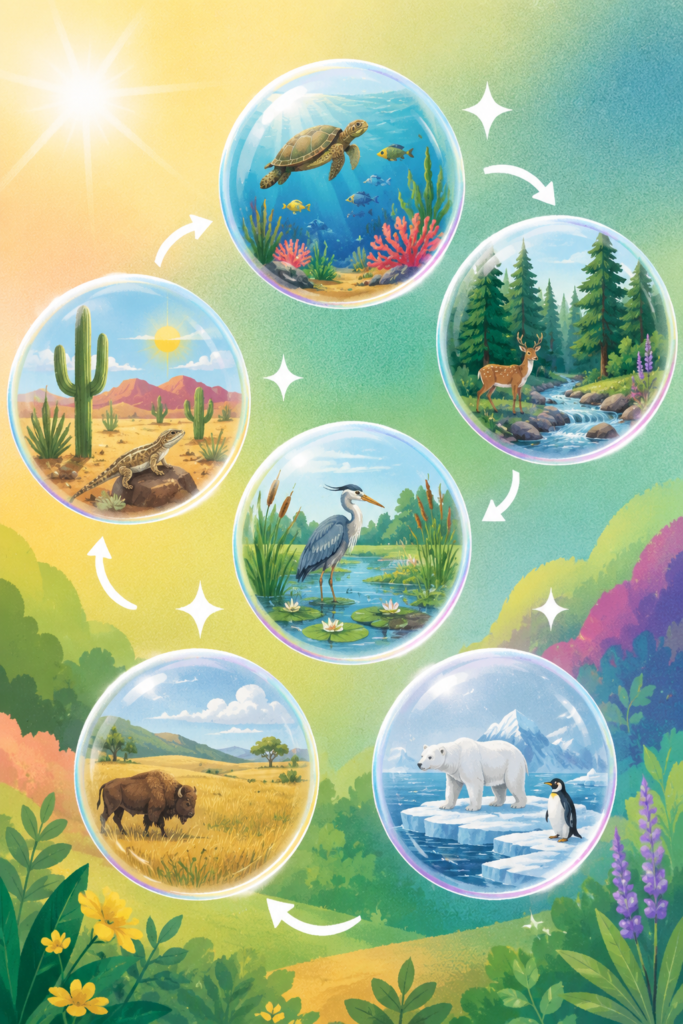
🌿 Ecosystems are all around us: from forests and ponds to backyards and gardens. As children learn how plants, animals, fungi, and other living things depend on one another, they begin to see nature as a connected system rather than a collection of separate facts.
In this guide, you’ll find free books and recommended reads, free activities, and simple ways to extend learning through observation and discussion. Choose the ideas that work best for your family, and enjoy exploring ecosystems together.
💡 What Kids Will Discover
As kids explore ecosystems, they’ll discover:
- how plants and animals depend on each other
- how energy flows through food chains and food webs
- the roles of producers, consumers, and decomposers
- how habitats support a variety of living things
- the relationships between predators and prey
- how living things interact within ecosystems
- how biodiversity, environmental change, and human activities affect the balance of nature
📚 Free Books
| Grades 3 – 5 | Grades 5 – 7 |
|---|---|
| Nonfiction | Nonfiction |
| Ecosystems: Overview with glossary and comprehension questions. | Earth’s Ecosystems: Overview with glossary and comprehension questions. |
| Pond Life: Explore the living things in a pond ecosystem. | Atacama Desert Unique features of this desert ecosystem. |
| Animal Migration How and why different animals migrate | Snakes Are Awesome: Learn interesting facts about snakes. |
| Animal Observers: Highlights the work of four scientists and their observations of animals. | Eugenie Clark Shark expert Zoologists: Read about how these scientists study animals and help zoos design habitats. |
| Spotting BIrds Identifying birds and how to spot them | DK Guide to Birds |
| Fiction | Fiction |
| Cactus Hotel: Follow a saguaro cactus as it grows and provides vital food and shelter to a web of desert animals. | Surprises in the Desert: With its setting in the Chihuahuan Desert, the story illustrates the roles of local plants and animals, and the application of survival knowledge within a harsh environment. |
📚 Additional Books
(As an Amazon Associate I earn from qualifying purchases)
| Grades 3 – 5 | Grades 5 – 7 |
|---|---|
| Nonfiction | Nonfiction |
| Inside Ecosystems & Biomes: Illustrated reader covers multiple biome types, with charts, graphs, easy-to-read text, and hands-on experiment. | Biomes: Discover the Earth’s Ecosystems with Environmental Science Activities for Kids Covers 9 biomes in depth with STEM activities, links to videos, comics, critical thinking prompts. |
| The Fascinating Ocean Book for Kids: 500 Incredible Facts! Short, bite-sized facts covering an array of sea creatures in ocean ecosystems | DK Eyewitness: the Amazon Explores the rainforest biome, including climate, plant life, animals, and ecological relationships. |
| An Anthology of Intriguing Animals: Covers 100+ animals with habitat information, behaviors, and cultural myths. | Face to Face with Wolves Follows the lives of wild wolves showing how they hunt, communicate, raise young, and help maintain the balance of their ecosystem. |
| Who Was Jane Goodall? Illustrates how field scientists observe and understand wildlife in their natural habitats, bringing real-world research methods and conservation values to life. | Who Was Rachel Carson? Discover how Rachel Carson’s groundbreaking research helped launch the modern environmental movement and changed the way we protect ecosystems. |
| The Secret Jobs of Backyard Creatures Each creature’s “job” mirrors its real ecological function — decomposing, pollinating, aerating, etc. — turning your own backyard into a living field guide. | Butterfly Eyes and Other Secrets of the Meadow Combines poetry, riddles and factual information to explore the interconnected relationships between meadow creatures and plants. |
| Fiction | Fiction |
| A Wolf Called Wander Told from the perspective of a wolf, this novel illustrates habitat, territory, predator-prey relationships, and ecosystem balance. | Out of the Deep (Part of the Mysteries in Our National Parks series) Set in Acadia National Park and centered around stranded marine mammals, highlights tidal zones, habitat dependence, human threats to ecosystems, wildlife management and conservation. |
| The Wild Robot Can spark discussions about habitats, animal behavior, adaptation, ecosystems, and the relationships between living things. | There’s an Owl in the Shower Centers on a family learning to care for an endangered spotted owl, highlighting old-growth forest ecology and wildlife protection. |
📚 Keep Browsing
Other places to find lists of fiction books by topic:
Reinforce what you’re studying while encouraging your kids to follow their interests. Check libraries for:
- nature reference books with photographs, diagrams, and facts about plants, animals, and ecosystems
- nonfiction books about specific ecosystems (rainforests, oceans, deserts, forests, or wetlands)
- books about animals and their habitats — discover how a species finds food, survives, and interacts with its environment
- biographies or spotlights on scientists who study nature (such as an ecologist, naturalist, wildlife researcher, or conservation scientist)
- field guides to local plants, animals, birds, or insects
🌱 Connect What You Read
Choose one or two simple activities to help your kids make connections between what they read and the world around them, using little more than curiosity, a notebook, and a pencil.
👀 Observe & Record: Step into your backyard, or visit a neighborhood park or other natural area. Look for plants, animals, insects, fungi, or signs of decomposition. Sketch or list what you find, then describe how two or more living things might be connected.
🌿 Follow the Food Chain: Choose one living thing you observed or read about and create a simple food chain showing where it gets its energy.
🌞 Energy Flow in Living Things: Activities to model how energy flows from the sun through food chains.
🧪 Soil Science Experiment: Learn how important nutrients cycle through an ecosystem.
👀 Backyard Biodiversity: Survey an area outdoors to see how many bugs you find and their habitats.
🌎 Keep Exploring
Continue building life science background knowledge with these free resources:
- Free World Biomes Readers
- Food Chain Picture Books & Activities
- Life Cycles Printables & Activities
- Ecology & Environmental Science
- Core Knowledge has Ecosystem Units for elementary and middle school with lesson plans, teaching guides and readers.
Next Up: Human Body Books for Kids